



Orthopedic Instrument OEM
The Orthopedic Instrument OEM Manufacturer!
Founded in 2001, who focus on R&D, manufacturing, sales and services in orthopedics& arthroplasty field, main products range from trauma, spine implants & hip and knee replacement to related surgical instruments.




Why choose us
OEM/ODM
We Offer complete solutions and scalable services from concept to commercialization, eg: concept development, product design, contract engineering, prototyping, testing, and contract manufacturing for medical devices etc like OEM/ODM mode.
Production Market
With ISO/CE certified quality, the company's sales network is throughout the country and has exported to different countries and regions in Asia, South America, Middle East, north America.
Rich Experience
Who offers concept development, product design, contract engineering, prototyping, testing, and contract manufacturing for medical devices with rich experience.
Production Equipment
60 CNC turning centres, 30 CNC milling centres as well as laser systems for marking and welding of assembly groups and special machines.
|
Benefit |
Result |
|
Precise alignment |
Better function, less wear |
|
Sizing accuracy |
Natural movement, reduced instability |
|
Standardized instruments |
Shorter surgery time, repeatable results |
|
Safe soft tissue handling |
Reduced complications |
|
Advanced technology support |
Robotic or navigation-assisted surgery |
|
Use of trial components |
Verification before final implant |
Advantages of Orthopedic Instrument
Precision and Control in Surgical Orthopedics
One of the biggest advantages of orthopedic surgical instruments is the level of precision they offer. These tools are designed to allow exact movements during surgery. This control is important when dealing with bones and delicate tissues. Even a small mistake can lead to serious complications. That's why high-quality tools are a must in surgical orthopedics.
Reduced Patient Trauma and Faster Recovery
Another major advantage of orthopedic surgical instruments is that they reduce trauma to the body. When surgeries are performed with sharp, accurate tools, there is less damage to surrounding tissues. This means patients experience less pain and heal more quickly.
Improved Surgical Efficiency
Orthopedic surgical instruments are designed to improve the efficiency of every procedure. With a complete orthopedic instruments set, the surgical team can focus on the operation without searching for tools. This saves time and keeps the surgery organized from start to finish.
Support for Minimally Invasive Techniques
Today's surgical trends favor less invasive procedures. These techniques are possible only with specialized orthopedic surgical instruments. Smaller tools make it easier to perform surgeries through tiny cuts, which cause less pain and reduce healing time.
Consistency in Surgical Results
Consistency is another benefit of using top-quality orthopedic surgical instruments. When tools are reliable, surgeons can perform at their best every time. Consistent results lead to better patient trust and fewer follow-up procedures.
Durability and Long-Term Value
Orthopedic surgical instruments are usually made from stainless steel or titanium. These materials are strong, easy to clean, and resistant to rust. As a result, these instruments last a long time with proper care. They can be reused in many surgeries, which makes them cost-effective for hospitals and clinics.
Some of the most commonly used orthopedic surgical instruments

Bone Cutting Instruments: Bone cutting instruments are used to cut through hard bone tissue during surgical procedures. Some of the commonly used bone cutting instruments include saws, drills, and osteotomes.
Bone Holding Instruments: Bone holding instruments are used to hold and stabilize bones during surgical procedures. These instruments include bone clamps, bone hooks, and bone retractors.
Screwdrivers: Screwdrivers are used to insert and remove screws, which are used to secure bones and implants during surgical procedures. Orthopedic screwdrivers come in a range of sizes and shapes to accommodate different types of screws.
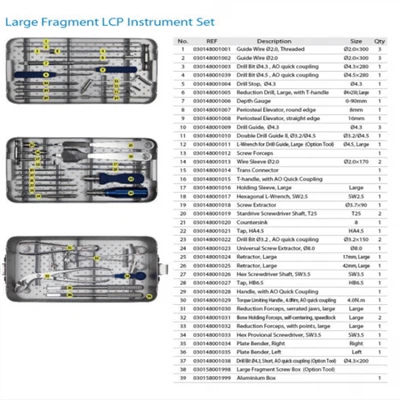
Plating Instruments: Plating instruments are used to place and secure plates and screws to stabilize broken bones. These instruments include plate benders, plate cutters, and screwdrivers.
Arthroscopic Instruments: Arthroscopic instruments are used to perform minimally invasive orthopedic surgeries. These instruments include arthroscopes, which are used to visualize the joint, and arthroscopic shavers, which are used to remove damaged tissue.
Retractors: Retractors are used to hold soft tissues away from the surgical site during orthopedic surgeries. These instruments include hand-held retractors, self-retaining retractors, and wire retractors.
Elevators: Elevators are used to lift and separate tissues during surgical procedures. These instruments include periosteal elevators, which are used to separate bone from soft tissue, and nerve elevators, which are used to separate nerves from surrounding tissues.

Packaging & Delivery
|
Packaging |
Inner: Non-sterile plastic bags. Small packing PE/PET, Big packing PVC. External: Standard carton. |
|
Lead Time |
7-14 days |
|
Delivery |
≤30kg, Door to door (DHL/TNT/UPS/FEDEX/EMS, etc.) >30 kg, Airport to Airport. By air or by sea. |
Our factory
FUXIANG medical metal produces medical implants/ instruments, as well as high-precision mechanical and precision CNC turned and milled components, wire-cutting components, ready-to-install assembly groups and 3D parts with free-form contours for a variety of industries.

FAQ