

For orthopedic brand owners and distributors sourcing a trauma fixation line from China, the hardest decision usually isn't "which factory" - it's "which implant architecture actually fits our target surgeons' case mix." Adding a locking plate system when your market mostly treats femoral shaft fractures wastes tooling budget; the reverse is equally costly. Before locking in an OEM/ODM manufacturer, procurement teams need a clear, evidence-based comparison of how plates and nails behave biomechanically, what each costs in lead time and MOQ, and which supplier can actually execute both reliably.
This guide breaks down the two most common trauma fixation architectures side by side, walks through a practical 5-step selection process for OEM buyers, and shows the verifiable manufacturing credentials behind one 24-year Tianjin-based factory currently producing both systems.
1. Two Fixation Philosophies: Plates vs Nails at a Glance
Click a tab below to compare the two flagship products behind this guide - both currently in production and available for OEM/ODM customization.
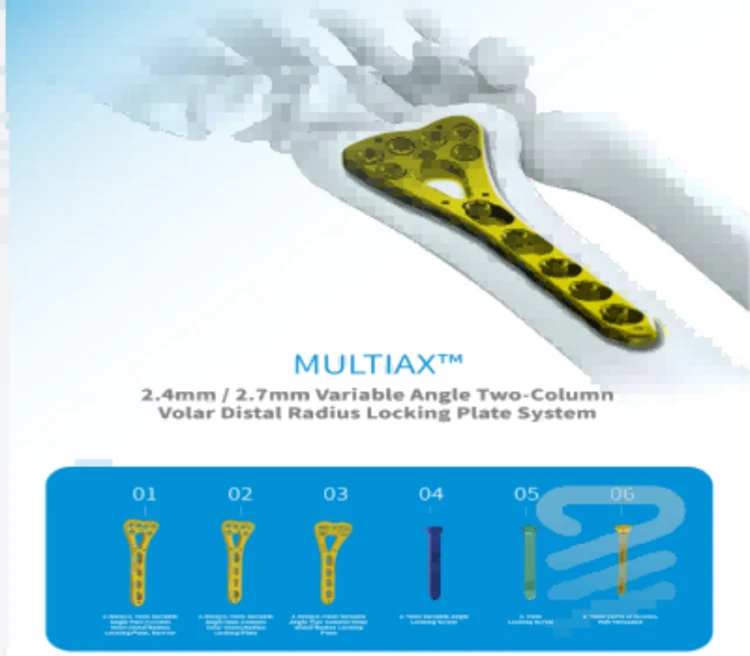
Variable Angle Distal Radius Locking Plate
The combination locking/compression hole forms a figure-8 profile that locks screws at either side, while the anatomically pre-contoured body reduces soft-tissue irritation around the wrist.

Femoral Reconstruction Interlocking Nail
Load-sharing design allows early weight bearing and works well in osteoporotic or metastatic bone, with proximal and distal interlocking screws stabilizing both fragments.
2. Locking Plate Advantages: Precision for Peri-Articular Fractures
Locking plate systems remain the go-to architecture for fractures near a joint - distal radius, distal humerus, proximal tibia - where anatomical reduction matters more than raw axial load capacity. Independent implant-quality studies cited by the manufacturer show that low-quality plate implants fail at a rate of 15-20%, versus under 3% for gold-standard implants, which is why material selection and CNC tolerance control are non-negotiable at the OEM sourcing stage.
Titanium-bodied plates also carry a clinical safety edge: titanium is hypoallergenic and studies show titanium implants cut post-surgical infection rates by roughly 40% compared with nickel-containing stainless alloys, while HA-coated implants can reduce healing time by up to 30%. For buyers building a premium-tier catalog, specifying titanium with an optional HA coating is a differentiator worth discussing with your OEM engineering team early - it affects tooling, not just packaging.
3. Locking Plate vs Intramedullary Nail: Interactive Comparison
Fixation choice depends heavily on fracture location. Use the buttons below to see which architecture is typically preferred for each scenario - the matching column will highlight.
| Comparison Factor | Locking Plate | Intramedullary Nail |
|---|---|---|
| Biomechanics | Fixed-angle, load-bearing | Load-sharing, central axis |
| Best-fit fracture zone | Peri-articular / distal (radius, tibia plateau) | Long-bone shaft / intertrochanteric |
| Soft-tissue disruption | Moderate - open or MIPO approach | Lower - closed, minimally invasive insertion |
| Early weight bearing | Case-dependent, often delayed | Generally supported earlier |
| Osteoporotic bone performance | Screw pull-out risk higher | Better load distribution |
| Material options | Titanium / Stainless Steel | Titanium alloy / Stainless Steel |
| OEM lead time (standard) | 7-14 working days | 7-14 working days |
| OEM low MOQ | 50 sets | 50 sets |
A fair comparison: neither architecture is universally "better" - the right choice tracks fracture location and bone quality, not brand preference.
4. How to Choose: A 5-Step OEM Selection Guide
Tap each step to expand the detail - this is the sequence experienced procurement teams follow before issuing a trauma implant OEM purchase order.
5. Why Buyers Source Both Systems From One Factory
Tianjin Fuxiang Medical Tech Co., Ltd. has manufactured trauma, spinal and joint implants for 24 years, giving OEM/ODM partners a single, audited supply chain for both plate and nail architectures instead of splitting orders across two factories.
Production runs across 60 CNC turning centres and 30 CNC milling centres, plus dedicated laser marking and welding lines for assembly groups, all under ISO13485-aligned quality control. The factory's sales network already covers Asia, South America, the Middle East, North America and Europe under OEM/ODM and distributor models. See the full production line at the Trauma Orthopedic Implants OEM category page.

6. Frequently Asked Questions
Tap a question to reveal the answer.
Sourcing a Trauma Implant Line - Plate, Nail, or Both?
Send your target fracture types and volume, and our engineering team will recommend a matched plate/nail OEM configuration.
Request a Quote WhatsApp Us Email Our TeamThe right fixation architecture is the one that matches your surgeons' fracture mix and bone-quality realities - not the one your current supplier happens to stock. For custom configurations or a detailed OEM/ODM quotation covering both locking plates and intramedullary nails, contact FUXIANG's technical team directly.


