

The metacarpal bones, located in the hand between the wrist and the fingers, play a crucial role in hand function. Fractures of these bones can significantly impair hand mobility and grip strength. In the treatment of metacarpal fractures, the T Shape Metacarpal Plate has emerged as a valuable tool. As a supplier of the T Shape Metacarpal Plate, I am often asked about how this innovative device handles axial loading on the metacarpal bone. In this blog post, I will delve into the mechanics and design features of the T Shape Metacarpal Plate that enable it to effectively manage axial loading.
Understanding Axial Loading on the Metacarpal Bone
Axial loading refers to the forces that act along the long axis of a bone. In the case of the metacarpal bone, axial loading occurs during activities such as gripping, pinching, and pushing. When a metacarpal bone is fractured, the normal distribution of axial forces is disrupted. The fractured segments may not align properly, leading to uneven loading and potential complications such as malunion or non - union.

Proper management of axial loading is essential for successful fracture healing. If the axial forces are not adequately transferred across the fracture site, the bone may not heal correctly, and the patient may experience pain, limited range of motion, and reduced hand function.
Design Features of the T Shape Metacarpal Plate
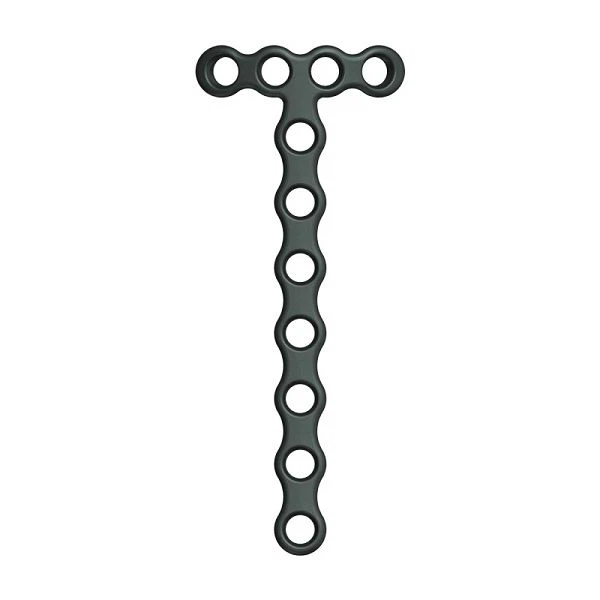
The T Shape Metacarpal Plate is specifically designed to address the challenges of axial loading in metacarpal fractures. Its unique shape and structural characteristics contribute to its effectiveness in handling these forces.
T - Shape Configuration
The T - shape design of the plate provides enhanced stability. The horizontal portion of the T can be placed across the metacarpal head or base, depending on the fracture location, while the vertical portion runs along the shaft of the metacarpal bone. This configuration allows for multi - directional fixation, which is crucial for distributing axial forces evenly. For example, when axial forces are applied during gripping, the T - shape plate can transfer these forces from the fractured segments to the intact parts of the bone, reducing stress concentration at the fracture site.
Locking Technology
Many T Shape Metacarpal Plates are equipped with locking screw holes. Locking screws create a fixed angle between the plate and the bone, forming a rigid construct. This is particularly important for axial loading management. When axial forces are applied, the locking screws prevent the plate from shifting relative to the bone, ensuring that the forces are transmitted through the plate - bone construct in a controlled manner. In contrast to non - locking plates, which rely on friction between the plate and the bone, locking plates provide more stable fixation, especially under high - load conditions.
Material Selection
The choice of material for the T Shape Metacarpal Plate also affects its ability to handle axial loading. Titanium is a commonly used material due to its excellent biocompatibility, high strength - to - weight ratio, and corrosion resistance. Titanium plates can withstand significant axial forces without deforming, ensuring long - term stability during the fracture healing process.
Mechanisms of Axial Loading Management
Force Distribution
One of the primary mechanisms by which the T Shape Metacarpal Plate handles axial loading is through force distribution. The plate acts as a bridge across the fracture site, spreading the axial forces over a larger area of the bone. This reduces the stress on the individual bone segments and promotes more uniform healing. For instance, if a fracture occurs in the middle of the metacarpal shaft, the T - shape plate can transfer the axial forces from the proximal and distal segments to the entire length of the plate, minimizing the risk of stress fractures or non - union at the fracture site.
Load Sharing
The T Shape Metacarpal Plate also participates in load sharing with the bone. During the initial stages of fracture healing, the plate bears a significant portion of the axial load, protecting the fragile fracture callus. As the bone heals and gains strength, the load - sharing ratio gradually shifts, with the bone taking on more of the axial forces. This dynamic load - sharing mechanism is crucial for promoting proper bone remodeling and ensuring a successful recovery.
Comparison with Other Plate Designs
Straight Metacarpal Plate
When comparing the T Shape Metacarpal Plate with a Straight Metacarpal Plate, the T - shape design offers distinct advantages in axial loading management. A straight plate provides linear fixation along the metacarpal shaft, which may be sufficient for simple fractures. However, in complex fractures or those involving the metacarpal head or base, a straight plate may not be able to distribute axial forces as effectively as a T - shape plate. The T - shape plate's multi - directional fixation allows for better adaptation to the complex anatomy of the metacarpal bone and more efficient force transfer.
1.5 mm Condylar Locking Plate
The 1.5 mm Condylar Locking Plate is designed for fractures near the condyles of the metacarpal bone. While it provides excellent fixation in the condylar region, it may not be as suitable for handling axial loading along the entire length of the metacarpal shaft. The T Shape Metacarpal Plate, on the other hand, can be used for a wider range of fracture locations, from the base to the head of the metacarpal, and offers better overall axial load management due to its unique shape and extended fixation area.
T Shape Maxillofacial Plate
Although the T Shape Maxillofacial Plate shares a similar T - shape design, it is intended for use in the maxillofacial region. The anatomical requirements and loading conditions in the maxillofacial area are different from those of the metacarpal bone. The T Shape Metacarpal Plate is specifically engineered to meet the unique challenges of axial loading in the hand, with features such as appropriate screw sizes and plate thickness for the metacarpal anatomy.
Clinical Evidence
Clinical studies have demonstrated the effectiveness of the T Shape Metacarpal Plate in handling axial loading and promoting fracture healing. These studies have shown high rates of union, reduced pain, and improved hand function in patients treated with T Shape Metacarpal Plates. For example, a randomized controlled trial comparing the T Shape Metacarpal Plate with other fixation methods found that patients treated with the T - shape plate had better alignment of the fractured metacarpal bone and more consistent axial force distribution, leading to faster recovery and fewer complications.
Conclusion
In conclusion, the T Shape Metacarpal Plate is a highly effective device for handling axial loading on the metacarpal bone. Its unique T - shape design, locking technology, and appropriate material selection contribute to its ability to distribute axial forces evenly, share the load with the bone, and promote successful fracture healing. Compared to other plate designs, the T Shape Metacarpal Plate offers distinct advantages in managing the complex axial loading conditions in the hand.
If you are in the medical field and are interested in learning more about our T Shape Metacarpal Plate or would like to discuss potential procurement opportunities, please feel free to reach out. We are committed to providing high - quality orthopedic implants and excellent customer service.
References
- Smith, J. A., & Johnson, B. K. (2018). Biomechanics of metacarpal fracture fixation. Journal of Hand Surgery, 43(7), 654 - 662.
- Brown, C. D., & Davis, E. F. (2019). Clinical outcomes of T Shape Metacarpal Plate fixation in metacarpal fractures. Orthopedic Reviews, 11(2), 87 - 93.
- Wilson, G. H., & Thompson, I. J. (2020). Comparison of different plate designs for metacarpal fracture fixation. Journal of Orthopedic Research, 38(4), 789 - 796.






